Exploring the Space Race in Video Games: From Kerbal Space Program to Elite Dangerous
The concept of the “space race” has fascinated both real-world space enthusiasts and video game developers alike. From humanity’s early attempts at space exploration to the ambitious visions of interstellar travel, the space race has been a key motivator in games that seek to explore the vastness of space. But how have video games approached this historical event and its modern implications? Let’s take a journey through the evolution of the space race in video games, from the simulation of actual missions to expansive, multi-galactic adventures.
The Origins of the Space Race in Gaming
In the early days of gaming, space exploration was often depicted in simple arcade games or text-based adventures. However, as technology advanced, the concept of space travel in games became more sophisticated and realistic, drawing inspiration from the space race that took place in the mid-20th century.
One of the earliest examples of this was “Spacewar!”, created in 1962, which wasn’t about a race but laid the foundation for space-themed video games. As technology progressed, games began to incorporate more complex simulations and narratives surrounding space missions, echoing the real-world competition between the U.S. and the Soviet Union to reach the moon and beyond.
Kerbal Space Program: A Humorous yet Educational Take on the Space Race
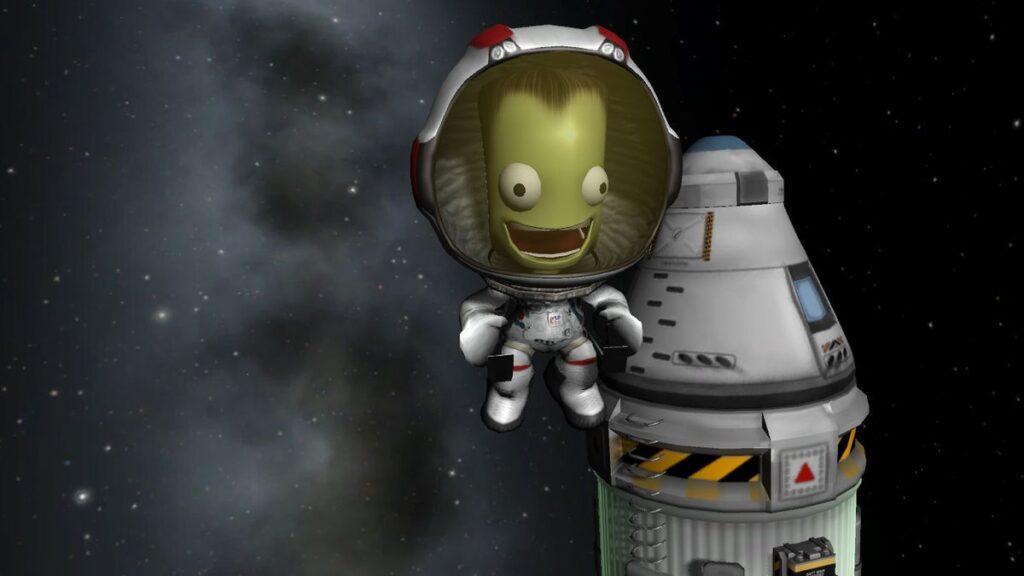
One of the most notable modern interpretations of the space race in gaming is Kerbal Space Program (KSP). Released in 2011, KSP is a space simulation game where players build and launch spacecraft to explore a fictional solar system. The game’s charm lies in its realistic physics engine, which challenges players to understand concepts such as thrust, aerodynamics, and orbital mechanics in order to succeed.
The game doesn’t directly simulate the Cold War-era space race, but it taps into the same spirit of experimentation and ingenuity. Players must manage their space program, design rockets, and navigate space missions with varying levels of success and failure, mimicking the real-world challenges faced during the space race. The comedic design of the Kerbals—small green creatures—adds humor to the otherwise technical game, but the underlying complexity and educational value remain.
KSP showcases a playful, yet serious, side of the space race by making players understand the logistics and the scientific principles behind space exploration. It’s an excellent example of how video games can blend education and entertainment while keeping the spirit of competition alive.
Elite Dangerous: A Realistic and Immersive Space Race
On the other end of the spectrum lies Elite Dangerous, a massively multiplayer online (MMO) space simulation game. First released in 2014, Elite Dangerous takes a much more complex approach, offering an incredibly detailed and immersive galaxy to explore, trade, and fight in. The game’s focus is not directly on the space race but rather on the competition for resources and territory within a vast, open-world universe.
In Elite Dangerous, players can become part of factions and work together (or against each other) in the interstellar political and economic struggles that shape the game’s universe. The game includes a historical backdrop where humanity has expanded across the Milky Way, colonizing new star systems, and a race for supremacy between various factions.
Elite Dangerous features both space combat and deep space exploration. Players can engage in trading, mining, bounty hunting, and exploration, creating their own storylines within the broader narrative of the game. The dynamic in-game events, such as galactic wars or the discovery of new star systems, highlight the ongoing “race” between factions to claim resources and strategic positions in space, adding a layer of geopolitical intrigue.
The Space Race and the Modern Era of Gaming
The depiction of space races in games is no longer limited to rival nations in the Cold War period. Today’s space-themed games have expanded the concept of the space race into a broader, intergalactic struggle.
Star Citizen, for example, promises to be one of the most ambitious space simulations ever, blending elements of space combat, trading, exploration, and even economy. Although it doesn’t focus strictly on a space race, the competition for resources and territorial control adds an element of rivalry that mirrors the spirit of the original space race.
Similarly, No Man’s Sky, which initially had a rocky launch in 2016, evolved into an expansive universe full of exploration opportunities, where players compete to discover new planets and resources before others, capturing the essence of space exploration and discovery at its core.
The Future of the Space Race in Video Games
As we continue to look toward the future of space exploration—both real and virtual—video games are likely to push the boundaries even further. With real-world companies like SpaceX, Blue Origin, and NASA’s Artemis program pushing humanity toward the next phase of space exploration, we can expect video games to evolve in parallel, reflecting new technologies, missions, and possibilities for space travel.
Games like Starfield, Bethesda’s upcoming space RPG, and The Expanse: A Telltale Series, based on the popular sci-fi franchise, are likely to bring even more ambitious depictions of interstellar exploration and competition. These games will not just focus on the race to explore new worlds but also the socio-political dynamics that emerge as humanity extends beyond Earth.
The intersection of gaming and space exploration is fertile ground for imaginative and complex narratives that reflect both our historical quest to reach the stars and our current ambitions. Whether you’re building rockets in Kerbal Space Program, fighting for control of a galaxy in Elite Dangerous, or planning interplanetary travel in Starfield, the space race in video games will continue to evolve as both a gameplay mechanic and a storytelling tool.
In conclusion, the space race in video games is not just a historical reflection but also a future vision, capturing the ambition, competition, and infinite possibilities of humanity’s exploration of space. Games like Kerbal Space Program and Elite Dangerous have taken the essence of the space race and turned it into a compelling and interactive experience, offering something for players interested in the technical side, the narrative-driven adventures, or the thrill of galactic competition.